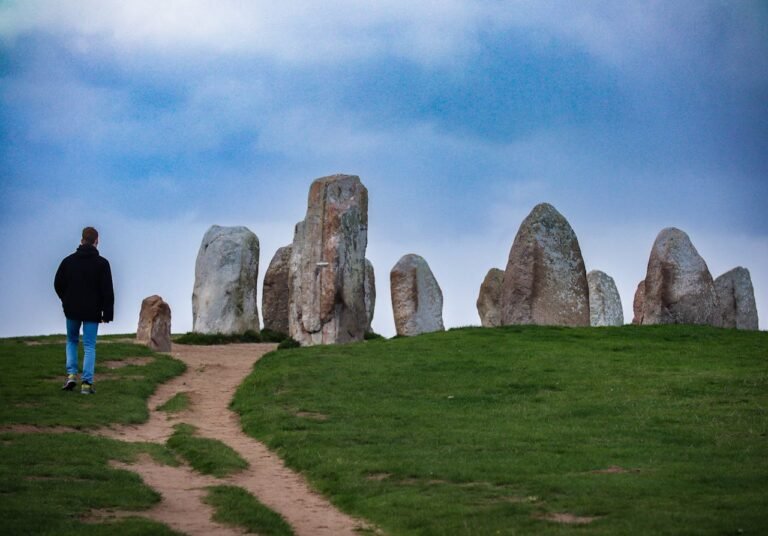
You can find some of the most interesting Viking Age remains in Sweden in the Stockholm area, especially in the old cultural landscape of Uppland. People often consider Vikings to be just raiders who sailed the seas, but the sites around Stockholm show that they were a complex society with chieftains, lawmakers, farmers and early Christians who carved their stories into stone. Visitors can stand on rebuilt Viking bridges, read runestones that are 1,000 years old, explore Sweden’s oldest town and walk among the huge burial mounds of legendary kings within an hour’s drive of the city center.
With over 2,500 inscriptions, mostly from the 11th century, Uppland province has the most runestones in the world. These stones, which families often put up to remember loved ones who have died or to show their status and land ownership, give us direct, personal links to the Viking Age. The following five places are the most important and easy-to-reach Viking sites in and around Stockholm. They range from the spiritual center of Old Uppsala to lesser-known gems like the processional road at Rösaring.
Top 5 Historical Viking Sites in and Around Stockholm
- Gamla Uppsala (Old Uppsala)
- Sigtuna
- Jarlabanke Bridge and the Runriket (Rune Kingdom)
- Rösaring
- Broby Bro
A Closer Look at the Top 5 Historical Viking Sites in and Around Stockholm
1. Gamla Uppsala (Old Uppsala)
Gamla Uppsala, which is about 70 kilometers north of Stockholm, was one of the most important political, religious and cultural centers in Viking Age Scandinavia. Three huge burial mounds from the 6th century, before the Viking Age, are the most important things on the site. They are the graves of the powerful Svea kings who ruled the area. Old Norse sagas tell stories about legendary kings Aun, Egil and Adils who lived in these mounds, which are some of the biggest in Scandinavia. In the time of the Vikings (800–1050 CE), Gamla Uppsala remained a central gathering place for festivals, religious ceremonies and the Thing (assembly).
Key Points
- Royal burial mounds: Three mounds rise 11 meters high and stand out from a long way away. They were built between 500 and 600 CE.
- The Gamla Uppsala Museum has exhibits that include Viking Age artifacts, gold foils and explanations of Old Norse religion. Next to the mounds.
- The Thing assembly site was one of Sweden’s most important places for settling legal disputes and making laws during the Viking Age and the Middle Ages.
- Medieval texts describe a big temple in Old Uppsala that people built for Thor, Odin and Frey. Excavations have found signs of a big wooden building, but people still disagree on what it was.
Achievements
- Designated as one of Sweden’s most important historical sites.
- Listed as a candidate for UNESCO World Heritage status.
- Received the “Tourist Attraction of the Year” award from the Swedish Tourism Association.
Feedback
Even without a lot of work done on the site, visitors always say the mounds are “humbling” and “powerful.” People say very nice things about the museum’s exhibits and English translations. You can walk to the site from any direction. Some visitors say the mounds are grass-covered and show no signs of excavation, so you must imagine what they looked like when first built. You should plan to spend 2 to 3 hours there to see both the mounds and the museum.
Contact
Website: https://www.gamlaupssala.se
2. Sigtuna
Sigtuna, which was founded around 980 CE, is the oldest town in Sweden that is still standing today. Sigtuna was built on the shores of Lake Mälaren during the late Viking Age. It was planned from the start to be a Christian royal and commercial center, taking the place of the pagan ceremonial site at Old Uppsala as Sweden became Christian. The town still has its medieval street layout and visitors can see the remains of several stone churches built in the 12th and 13th centuries on top of older Viking-era wooden buildings. These churches include St. Olof, St. Lars and St. Per. There are also over 150 runestones in Sigtuna, which is another thing that makes it interesting.
Key Points
- Runestones in town: There are about 150 runestones built into the city, including the well-known “Dragon Stones” with dragon carvings.
- Church ruins: Three well-preserved stone church ruins from the early Middle Ages that you can visit for free.
- Main Street (Stora Gatan): Sweden’s oldest main street, which has been in the same place since the Viking Age.
- The Sigtuna Museum is in the old town hall and displays Viking Age and medieval artifacts that archaeologists found during the town’s excavation.
Achievements
- Founded around 980 CE, Olof Skötkonung was Sweden’s first Christian king and established the royal seat.
- One of the richest runestone concentrations in Scandinavia.
- Recently named one of the “most beautiful small towns in Sweden” by Swedish Traveller magazine.
Feedback
Visitors to Sigtuna appreciate its real Viking history and charming, walkable town feel. The small size (fewer than 10,000 people) means that crowds are easy to handle even in the summer. People really like the church ruins because they are free to visit and have signs that explain things. Because the town is close to Arlanda Airport, it’s convenient for travelers with layovers to stop there.
Contact
Website: https://www.visitstockholm.com/o/sigtuna/
3. Jarlabanke Bridge and the Runriket (Rune Kingdom)
The Runriket, or “Rune Kingdom,” is a protected cultural heritage site in Vallentuna and Täby municipalities, about 20 kilometers north of Stockholm. This area has one of the highest concentrations of runestones in the world. Many of them were put up by the powerful Jarlabanke clan in the 11th century. The main attraction is the Jarlabanke Bridge, which is a rebuilt Viking causeway that the chieftain Jarlabanke built to show off his power and make it easier for people to cross wet ground. The original bridge let Vikings cross the wetland and now people can walk across the rebuilt bridge and read the runestones next to it.
Key Points
- Jarlabanke Bridge: A Viking bridge that was partially rebuilt and dates back to about 1020–1050 CE. The nearby runestone says that Jarlabanke “had this bridge built for his soul’s sake.”
- More than 25 runestones are within walking distance, including stones that say Jarlabanke “owns all of this hundred,” which is a traditional administrative district.
- Arkils Tingstad: A preserved Viking Age assembly site where local things (parliaments) met to settle disputes and make laws.
- Lake Vallentuna setting: The sites are spread out around a beautiful lake and there are bike and walking paths that connect them.
Achievements
- Home to the Jarlabanke Runestones, designated as ancient monuments of national interest.
- Arkils Tingstad is one of the best-preserved Viking meeting places in Scandinavia.
- CNN and other international news outlets have called it a key Viking heritage site.
Feedback
Visitors rate the Runriket highly for its accessibility—free parking, well-marked paths and excellent information boards in both Swedish and English. The ability to touch 1,000-year-old carvings (runestones are protected but not glassed over) creates an unusually direct connection to history. The sites are spread over several kilometers; cycling or driving between locations is recommended rather than walking all segments.
Contact
Website; https://www.runriket.se
4. Rösaring
Rösaring, in the Upplands-Bro municipality about 35 kilometers west of Stockholm, is one of the most remarkable and atmospheric Viking sites in the area. The site is on a gravel ridge that is 60 meters high and has a 540-meter-long processional road that dates back to around 800 CE, which is when the Viking Age began. There is a 17-meter-diameter stone labyrinth (the “Rösaring” itself), several grave mounds and stone circles at the southern end of this road. Archaeologists think that the site may have been a place for rituals or ceremonies, like processions for funerals or seasonal festivals like the summer solstice.
Key Points
- Processional road: A 540-meter-long, 3-meter-wide stone-lined path that is one of a kind in Sweden and was probably used for ceremonial processions.
- Stone labyrinth: A stone maze with a 17-meter diameter. People thought that labyrinths had magical or spiritual meaning and might have been used in rituals.
- Burial mounds: There is an Iron Age grave field with about 200 graves that can be seen below the ridge.
- Perspective: Rösaring’s height gives you amazing, unobstructed views of Mälaren.
- Access: You can visit any time of year for free. There is parking and an information board at the north end of the road.
Achievements
- Designated as a nature reserve (Rösaringsåsens naturreservat) in 2015 to protect both natural and cultural values.
- Described by Stockholm County Museum as containing “Uppland’s most remarkable ancient monuments.”
- The processional road has been dated through archaeological excavation to the early Viking period.
Feedback
People who visit Rösaring say it is “magical” and “eerie,” and they say that the remote forest setting and one-of-a-kind monuments make it different from other Viking sites. The 540-meter walk along the processional road is a highlight because visitors can actually walk the path. People who celebrated in Viking times would have walked. The site gets fewer visitors than Gamla Uppsala or Sigtuna, so you can be alone there even in the summer. You need sturdy walking shoes because the forest trails are uneven.
Contact
Website: https://www.lansstyrelsen.se/stockholm/rosaring
5. Broby Bro
Broby Bro, in the Runriket area of Täby municipality, is one of the most important Viking burial and runestone sites in Sweden. The site has a large grave field with both pre-Christian burial mounds and early Christian graves. This shows how religion changed in the 11th century. Estrid, a strong Viking woman, was one of the first Christians in the area and the grandmother of the chieftain Jarlabanke. The runestones here tell her story. Her family’s network controlled a lot of the area and her story is one of the most complete personal accounts from the Swedish Viking Age that we still have.
Key Points
- Estrid’s runestone: A well-preserved stone raised by Estrid’s son in her memory, providing details of her family and Christian faith.
- Mixed burial ground: Contains both pagan mound graves and flat Christian graves, visible as grass-covered depressions, demonstrating the gradual religious shift.
- Approximately 80 graves: Dating primarily to the Viking Age and early medieval period.
- Interpretive signage: Detailed signs in Swedish and English explain the runestone inscriptions and burial practices.
Achievements
- Broby Bro is one of the most important runestone sites in Sweden for learning about how Christianity spread.
- The runestone’s almost complete writing gives us a lot of information about family ties and how inheritance works.
- Part of the official Runriket heritage trail.
Feedback
People who visit Broby Bro say that it needs more explanation than sites with clear structures. The runestones are like stars and the grave field is hard to read because you have to look for signs to find things. The site is free, not too crowded and goes well with a trip to Jarlabanke Bridge, which is about 2 kilometers away. There is a small parking lot.
Contact
Website: https://www.runriket.se/broby-bro
FAQ
Which Viking site around Stockholm is the easiest to reach by public transport?
Sigtuna is the most accessible: take the commuter train (pendeltåg) from Stockholm Central to Märsta (approximately 35 minutes), then bus 570 or 575 to the Sigtuna bus station (15 minutes). Gamla Uppsala is also accessible: train to Uppsala Central (40 minutes) then bus 2 or walking (25 minutes). Rösaring and Broby Bro are difficult without a car.
Do I need to pay entrance fees for any of these Viking sites?
No. You don’t have to pay to visit any of the five sites listed. There is a fee to get into Gamla Uppsala Museum (about SEK 100–120 for adults, less for students and seniors), but the burial mounds and grounds are free. There are no fees or other barriers to getting into any of the other sites.
Which site is best for children or families?
Gamla Uppsala has the best family experience: a museum with things to do, open space to run between mounds and a café. Jarlabanke Bridge is fun to touch and walk across because it looks like runestones and a real bridge. Sigtuna has a lot of history, but it also has ice cream shops and playgrounds.
How accurate is the Jarlabanke Bridge reconstruction?
The bridge is being rebuilt on the original stone footings. Some of the stones are original, while others have been moved. The full wooden superstructure is open to interpretation, but the alignment and causeway are based on Viking-era engineering. The runestones next to it are real and in their original location. People think the site accurately shows how things were built in the 11th century.
Can I see Viking runestones within central Stockholm itself?
No. Stockholm has many historic sites from the Middle Ages and later, but there are no Viking runestones left in the city center. The closest runestones are in the outer districts of the Municipality of Stockholm, such as Spånga and Bromma. However, the most important groups of runestones are at the sites listed above.
What is the best time of year to visit these Viking sites?
The weather is mild, the days are long and there are fewer people in late spring (May–June) and early fall (September) than in July–August. Summer (July to August) is nice but busy, especially in Gamla Uppsala and Sigtuna. You can visit in the winter, but you need to wear warm clothes and drive carefully. Some places, like Rösaring’s forest road, may not be reachable after a lot of snow.
How much time should I plan for a self-guided Viking tour from Stockholm?
A focused day tour (8–10 hours) can take you to two important places, like Gamla Uppsala and Sigtuna (two hours each, plus travel) or the Runriket sites (Jarlabanke Bridge and Broby Bro, plus travel and lunch). If you want to see three or more sites on a full tour, you need to stay overnight in Uppsala or Sigtuna. Day trips from Stockholm usually only go to one of the following routes: the Uppsala/Sigtuna route or the Runriket route.
Are guided tours available?
Yes. Several companies offer day trips from Stockholm that last 5 to 9 hours and include all transportation and a guide’s commentary. Usually, guides are archaeologists or professional historians, not actors in costume. Common stops are Jarlabanke Bridge, Arkils Tingstad, Sigtuna and Gamla Uppsala. Prices range from about SEK 1,200 to SEK 2,500 per person, depending on how long the trip is and how many people are in the group.