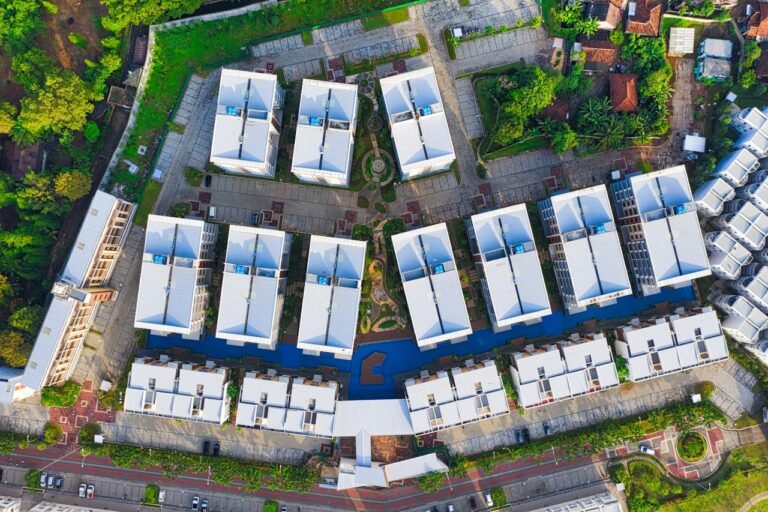
Malmö has gone from a declining industrial city to a European benchmark for sustainable urban development. The city’s commitment to 100% renewable energy by 2030, paired with ambitious social and environmental goals, has made it a living laboratory for innovative residential projects. In many cities sustainability still comes as an add-on. But Malmö has integrated ecological, social and economic concerns into the fabric of its neighborhoods, from the post-industrial reclamation of Västra Hamnen to the pioneering timber towers of Hyllie.
These five residential developments are the strongest examples of this transformation. They include a ground-breaking project that merges social integration with a fossil fuel-free construction site, a twelve-story timber building insulated with straw and a district that was the first in the Nordics to be awarded BREEAM Communities certification. They each show how sustainable housing can not only deliver lower carbon footprints but also better community, biodiversity and quality of life.
Top 5 Sustainable Residential Developments in Malmö
- Sjösättningen, Västra Hamnen
- ETC Hyllie
- Masthusen, Västra Hamnen
- Hyllie Terrace (Hyllie Terrass)
- MKB Fastighets New Build Programme
A Closer Look at the Top 5 Sustainable Residential Developments in Malmö
1. Sjösättningen, Västra Hamnen
Sjösättningen is a large residential block in Västra Hamnen, which is a pilot project for social sustainability for the City of Malmö. The project, completed in 2021, has retirement homes, a preschool, commercial space and rental apartments and condominiums of various sizes. The special thing with Sjösättningen is that it is an innovative response to the social demands of land allocation, developed in the workshops where Skanska has led a collaborative process together with different city administrations.
Key Points
- Social sustainability in focus: The project is based on the recommendations of the Malmö Commission for a socially sustainable city, in relation to conditions for children and young people to grow and for urban cohesion.
- Yalla Trappan integration: A commercial premise rented out at a reduced rent to Yalla Trappan, a work-integrating social enterprise and women’s cooperative creating jobs for women born abroad with little or no work experience.
- Mobility Solutions: On-site bicycle workshops from STPLN (a local incubator for technology, culture and craft) and a planned mobility pool with electric cargo bikes and electric cars available to all residents.
- Construction approach: Served as Skanska’s trial project for fossil fuel-free tools and machines on the construction site, contributing to reduced emissions during the building phase .
Achievements
- The pilot investment gives learnings to both Skanska and the city on how rewarding social sustainability in the land allocation can help municipalities to include more diverse values related to financial income from land sales.
- Creates human encounters between residents from different districts by successfully connecting parts of Malmö bringing a business to Västra Hamnen from Rosengård.
Feedback
The project has been identified as an example showing that “when social demands are set in procurement, private actors are engaged in generating societal benefits and building a long-term sustainable city” . The collaboration with STPLN creates several co-benefits: involving a non-profit actor, activating the residents and encouraging sustainable travel behaviours.
Contact Information
Website: https://group.skanska.com/projects/243727/Sjosattningen%2c-Malmo/
2. ETC Hyllie
The residential building ETC Hyllie is twelve stories high and is found in the Malmö district Hyllie. It’s setting new standards for timber construction and low-carbon materials. The building, developed by ETC Bygg AB, will be completed in early 2026 and contains 65 modern leasehold flats. The entire supporting structure of the project, including the elevator shaft, is wooden. The insulation of the exterior walls is industrially compacted straw. It is an innovative and environmentally friendly solution.
Key Points
- Supporting structure: The entire supporting structure consists of 1,814 m³ cross-laminated timber and 151 m³ glued laminated timber from the HASSLACHER Group, which was transported to the site by rail.
- Straw insulation: Industrial-scale insulation of exterior walls with compacted straw as a renewable, low-carbon alternative to conventional insulation materials .
- Reduced-cement foundations: Basalt and other materials that replace part of the climate-intensive cement in the concrete foundation.
- Photovoltaic integration: Large areas of the façade with photovoltaic modules for a self-sufficient energy supply.
- Crowdfunding financing: The project is financed by crowdfunding, organized by ETC Bygg AB, showing alternative financing models for sustainable housing.
Achievements
- Thanks to a high degree of prefabrication, the assembly of cross- and glued laminated timber elements, including insulation, was finished in less than five months.
- Future tenants will enjoy shared services such as an electric car pool and cargo bikes at no extra monthly cost.
- All the apartments have a balcony, which is intended for urban gardening to strengthen the feeling of community.
Feedback
The project underlines the potential for “sustainable and innovative timber construction methods in urban environments.” The use of entirely renewable materials for the structure (wood) and insulation (straw) represents a radical departure from conventional building practices, demonstrating that high-rise residential buildings can achieve near-zero embodied carbon.
Contact Information
Website: https://www.hasslacher.com/ETC-Hyllie-Malmoe-en
3. Masthusen, Västra Hamnen
Masthusen is the first neighborhood in the Nordics to be certified according to the international sustainability system BREEAM Communities. The urban development project that began in 2006 has turned Västra Hamnen, once home to Kockums shipyard, a car factory and exhibition halls, into a sustainable district with preschools, cafes, apartments, offices, student housing and a library. Skandia Fastigheter is now in the final development stage, including a residential building with a target of BREEAM-SE Very Good certification.
Key Points
- BREEAM Communities certification The district is certified under BREEAM Communities, which incorporates detailed demands for energy consumption, on-site energy production and rooftop or courtyard gardening.
- Mixed-use density: A dense, green, functionally mixed environment that is energy efficient and provides a good basis for sustainable transport and contributes to a richer street life.
- Final phase components: Includes BaseCamp’s first Swedish establishment (590 student apartments), approximately 500 additional homes, Malmö’s first mobility house and a preschool with green outdoor environments on both ground and roof levels.
- Mobility house: capacity for over 230 cars, commercial premises on the ground floor, a pool of electric cars, a pool of electric bikes, a bike service and a delivery room.
Achievements
- First Nordic district to achieve BREEAM Communities certification.
- Skandia Fastigheter is certifying the new residential building (77 rental apartments) to BREEAM-SE Very Good.
- The district will include a preschool certified to BREEAM-SE Excellent.
Feedback
BREEAM has a lot of requirements, such as “energy consumption, own energy production and rooftop or courtyard gardening,” says Fredrik Remstam, Project Manager at Skandia Fastigheter. The strength of the system lies in areas such as land use and ecology, where there is a direct relationship to the outdoor environments of the tenants. The early integration of BREEAM in the planning process is important: The early start of the certification work allows for more flexibility in the choice of which indicators the project wants to implement.
Contact Information
Website: https://www.swedentips.se/malmo/vastra-hamnen/
4. Hyllie Terrace (Hyllie Terrass)
Hyllie Terrace is a residential development in Hyllie that is ZeroCO₂ certified by the Sweden Green Building Council. The project, developed by Skanska, includes a broad spectrum of sustainable solutions in terms of materials, construction methods, energy systems and operational practices. The ZeroCO₂ certification requires that the climate footprint from the construction phase be fully compensated within 50 years, usually through on-site renewable energy generation.
Key Points
- ZeroCO2 certification: The certification created by the Sweden Green Building Council (founded by Skanska and 12 other companies in 2009) requires the construction phase to be offset for all emissions for the next 50 years, such as by adding solar panels to create energy over time.
- Low-carbon concrete: Climate-optimized concrete with up to 40 percent less carbon footprint.
- Recycled materials Supports for the building’s frame are reused and locally made glass from recycled materials.
- Biodiversity measures: biochar applied to soil and selected plants for biodiversity benefits.
- Circular economy: One-of-a-kind cooperation with Swedese turning construction waste into furniture.
- Green leases Green leases to support tenants making environmentally conscious choices.
Achievements
- Tools and machines on the construction site without fossil fuels.
- Terraces that capture rainwater and also function as detention reservoirs to assist in managing stormwater.
- Solar cells on the roof in collaboration with E.ON and Malmö City.
- Extend sustainability requirements through the supply chain Require suppliers and subcontractors to report their climate footprints.
Feedback
The ZeroCO₂ certification is one of the most demanding environmental standards for buildings in Sweden, demanding not only reduced emissions during construction but full compensation within 50 years. Hyllie Terrace shows how this can be done with a mix of material choices (low-carbon concrete, recycled content), construction practices (fossil-fuel-free tools) and operational measures (on-site solar generation).
Contact Information
Website: https://www.skanska.se/
5. MKB Fastighets New Build Programme
MKB Fastighets AB, the largest municipal housing company in Malmö, is constructing over 1,500 new energy-efficient homes in 13 residential buildings supported by a €225 million loan from the European Investment Bank (EIB). Mostly one to four bedrooms, the homes will exceed the national standards for energy performance, with phased deliveries scheduled until 2029. The loan represents the EIB’s seventh operation with Malmö since 1995, strengthening a long-standing collaboration for sustainable urban development.
Key Points
- Scale: 13 residential buildings to provide over 1,500 new homes, predominantly one to four-bedroom apartments.
- Energy performance: Homes will be built to a higher level of energy performance than the national requirements, which supports the climate objectives of Sweden and the European Union.
- EIB financing: a €225 million loan from the European Investment Bank, building on seven operations with the city since 1995.
- Demographic context: In Malmö the growth rate is faster than the national average and there is a demand for a substantial new housing supply.
- Malmö is important for the regional economy due to the connection to Denmark with the Öresund Bridge.
Achievements
- The initiative is “part of Malmö’s sustained growth” and plays a key role in accelerating local and European climate objectives.
- Phased deliveries scheduled until 2029 ensure a steady pipeline of high-efficiency homes.
Feedback
This program is sustainability at scale—not a one-off signature project, but a systematic approach to raising energy performance across thousands of homes. The cooperation of MKB with the EIB offers a scalable financing solution for landlords and housing cooperatives to learn about how sustainability can be incorporated into large-scale construction.
Contact Information
Website: https://www.nordicpropertynews.com/
FAQ
What is the most environmentally ambitious residential project in Malmö?
ETC Hyllie is the most radical departure from conventional construction, with an all timber structure, straw insulation, reduced cement foundations and photovoltaic facade integration . The project shows that high-rise residential buildings (12 stories) can be built with near-zero embodied carbon using renewable materials.
Which certification systems are used for sustainable buildings in Malmö?
Multiple certification systems are used in Malmö buildings. Masthusen was BREEAM Communities (first in Nordics). Hyllie Terrace has received the ZeroCO2 certification from the Sweden Green Building Council. The city also employs Miljöbyggnad (Bronze, Silver, Gold) and LEED certifications. In 2021, Malmö has 50 certified buildings in these systems.
How does Sjösättningen address social sustainability?
Sjösättningen was a pilot project for the City of Malmö on how land allocation can create social value. Highlights include leasing commercial space at reduced rent to Yalla Trappan (a women’s cooperative creating jobs for immigrant women) and collaborating with STPLN to provide on-site bicycle workshops and mobility services .
What makes ETC Hyllie’s construction method unique?
Three innovations distinguish ETC Hyllie: (1) the entire supporting structure—including the elevator shaft—is timber (cross-laminated and glued laminated timber); (2) exterior walls are insulated with industrially compacted straw rather than mineral wool or foam; (3) foundations use basalt and other materials to replace climate-intensive cement .
Is any of these developments affordable for average residents?
The city’s municipal housing company, MKB Fastighets, has a new-build program for homes for the growing population of Malmö at regulated rent levels. The sjösättningen will contain a mix of rental apartments and condominiums, with social sustainability measures designed to benefit diverse income groups. The ETC Hyllie project is financed through crowdfunding and leasehold flats and shared services are provided at no additional monthly cost.
What is the timeline for completing these developments?
ETC Hyllie is expected to be completed in early 2026. MKB’s 13 buildings will be delivered in phases until 2029. The final stage of Masthusen (77 rental apartments) was completed in December 2022. Launch was completed in 2021. Hyllie Terrace is on its way to help the district achieve the 2030 renewable energy target.
Which district has the most ambitious energy target?
The goal for the Hyllie district is to be fully powered by renewable or recycled energy by 2030 through integrated smart technology solutions implemented. The development includes smart grids, locally produced renewable energy, mandatory food waste sorting and urban gardening.
Are there any upcoming sustainable residential developments not yet completed?
Yes. Team Superlokal (Kjellander Sjöberg, Förstberg Ling and We Made That) won the Trollhättan 6 area on Nordenskiöldsgatan after an international competition. This mixed-use building with workspace, housing and community amenities on a 5100 m² site is scheduled to start construction in 2027.