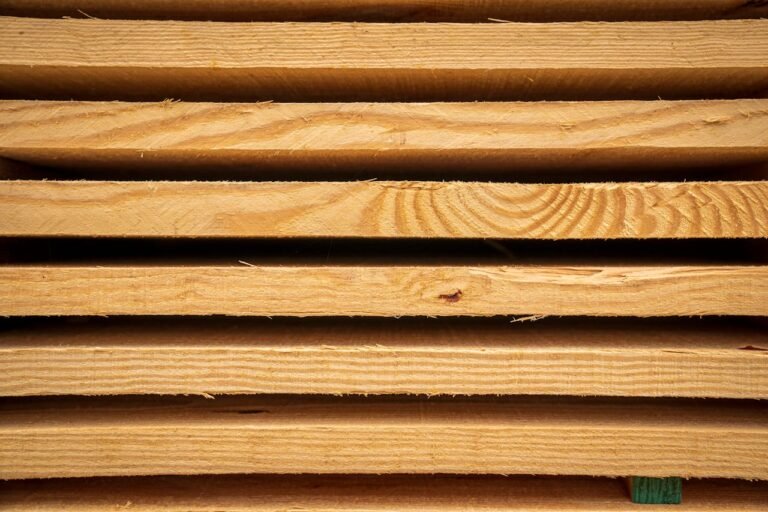
Thanks to the unique properties of slow-grown Nordic spruce and pine, Sweden’s timber industry is a world leader in high-quality, sustainable wood products. The long winters of these species result in tight annual rings, which in turn produce timber that is extremely hard, dimensionally stable and decay-resistant. The industry is a key economic driver, exporting approximately 88% of its sawn wood products to markets in Europe, the USA, Australia, Africa and Asia.
The Swedish timber industry is vertically integrated and value-adding is of great importance. Major manufacturers not only make sawn timber but also process it into sophisticated engineered wood products such as glulam (glued laminated timber) and cross-laminated timber (CLT), increasingly used to replace carbon-intensive materials such as steel and concrete in construction. These five companies below are the strongest representatives of this sector, from the biggest sawmill groups to specialists in prefabricated wooden bridges or energy production.
Top 5 Timber Product Manufacturers in Sweden
- Vida AB
- Setra Group
- Södra Skogsägarna (Södra Wood)
- Bergkvist Siljan
- Martinsons Trä AB
A Closer Look at the Top 5 Swedish Timber Manufacturers
1. Vida AB
Vida, the largest sawmill group in Sweden, strengthened its position significantly in 2025 by acquiring three more sawmills from AB Karl Hedin. Vida is a world leader in timber processing with 15 sawmills and 29 production plants. The company is very diversified, producing not only structural timber but also packaging, animal bedding, pellets and complete prefabricated buildings. They have a very high export orientation, with 88% of their production exported to international markets.
Key Products
- Sawn & Planed Timber Structural timber for construction and joinery and planed timber products made from sustainably sourced raw materials from Swedish forests.
- Engineered Wood Products Prefabricated volume building components for apartment buildings (about 300 units per year) and wooden houses (about 20 houses per year).
- Packaging Solutions: A massive packaging division producing 2.3 million pallets, 3.2 million pallet collars and 200,000 cable drums annually .
- Bioenergy & By-products: Production of wood chips, pellets (60,000 tonnes) and biofuel from sawmill by-products like bark and sawdust, supplying energy for local heating plants .
- Animal Bedding: A specialized product line utilizing wood fibre for agricultural and equine bedding .
Achievements
- Three new sawmills were acquired in 2025, raising the annual production capacity to 3.3 million cubic meters.
- Employs approximately 1,800 people across its operations .
- Turnover was SEK 13 billion, showing its position as a leader in the industry.
Contact Information
Website: https://www.vida.se
2. Setra Group
Setra is one of Sweden’s largest companies in the wood industry and is owned by the forest owners’ association Mellanskog with 99.5%, which means that Setra is closely connected to responsible forestry . Unlike conglomerates that keep their divisions separate, Setra is a highly integrated company that specializes in processing raw timber into advanced climate-friendly building components for the global market. Setra has a strong export focus (68% of turnover) and supplies engineered wood solutions to Europe, North America, Asia and the Middle East.
Key Products
- Cross-Laminated Timber (CLT) Large solid wood panels for walls, roofs and floors. CLT has good strength and dimensional stability and can be a replacement for concrete in multi-story buildings.
- Glued Laminated Timber (Glulam): High-strength structural members made from layers of timber laminations. Glulam allows for longer spans and curved designs that are not possible with solid timber.
- Planned Timber & Components—Finished wood products and custom machined components ready for assembly in construction and furniture manufacturing.
- Bioproducts: Bark, chips and shavings sold to the paper and pulp industries and for energy generation mean that no waste is generated during the milling process.
Achievements
- Owns eight production sites in Sweden. Seven sawmills and a dedicated processing unit for CLT and glulam.
- Has a turnover of approximately SEK 5.1 billion.
- It is also home to a subsidiary, Pyrocell, which focuses on producing bio-oil from sawdust, a sign of advanced bioenergy.
Contact Information
Website: https://setragroup.com
3. Södra Skogsägarna (Södra Wood)
Södra is a large economic association with more than 50,000 forest owners and is one of the largest forest owners’ associations in Europe. Södra Wood, the company’s timber division, is a leader in solid timber construction products, even if the company is a giant in pulp production. In 2023, Södra opened a new CLT factory in a landmark move that increased their production capacity tenfold and positioned them to be the leader in the Nordic engineered wood market.
Key Products
- Södra’s main product is Cross-Laminated Timber (CLT). Their new factory produces panels up to 3.5 m x 16 m and 280 mm thick, which can be used as framing material for some 4,000 homes a year. Södra claims its CLT has the “lowest climate impact on the market” at 34 kg of CO₂ per square meter.
- Glulam: Strong laminated beams for structural applications.
- Construction Services: Södra provides digital design and engineering support as well as supplying materials. They take the architects’ drawings and make digital models to operate the cutting equipment in the factory, producing elements pre-milled with tracks for cables and pipes.
Achievements
- Commissioned a “significant” investment in a new CLT factory at Värö, increasing capacity from 8,000m³ to 80,000m³ per year.
- Generated 90 new jobs at Värö plant .
- Produces CLT with an Environmental Product Declaration (EPD) , showing that its carbon footprint is 20% of that of an equivalent prefabricated concrete structure .
Contact Information
Website: https://www.sodra.com
4. Bergkvist Siljan
Bergkvist Siljan is a sawmilling group with deep roots in the Dalarna region and three sawmills, all of which have been in operation for over a century. The group was created through the merger of two family owned businesses creating a synergy that has resulted in one of the most efficient production cost structures amongst the Nordic peers . Bergkvist Siljan is a specialized supplier of high quality pine and spruce with a strong focus on the requirements of joinery and furniture manufacturers. The company is now part of the Mayr-Melnhof Holz, a European wood giant.
Key Products
- Premium Sawn Timber: High quality sawn timber of pine and spruce, using raw materials from the Dalarna region. The wood is known for its high density and stability, making it ideal for furniture and joinery applications where appearance and durability are important.
- Planed Timber (Pine & Spruce): Planed products intended for further processing into mouldings, interior cladding and window elements .
- Industrial Components: Specialized timber components for the window and door industry, requiring precise dimensioning and moisture control .
Achievements
- Combined turnover is approximately SEK 2.7 billion.
- Has 285 employees across the three mills.
- Operates one of Sweden’s largest container terminals (40,000 TEU per annum), providing efficient logistics for global exports.
Contact Information
Website: https://www.bergkvistsiljan.com
5. Martinsons Trä AB
Martinsons is a family business based in Bygdsiljum, Västerbotten, which has developed into a leading manufacturer of high-tech, engineered wood components. While others focus on raw lumber, Martinsons has carved out a niche in complex wood construction, claiming the title of Sweden’s largest glulam producer and a leader in wooden bridges. They are the one-stop shop for advanced timber engineering with a focus on bridging solutions and solid wood frame building systems.
Key Products
- Glulam (Glued Laminated Timber): Martinsons is a pioneer in glulam beams with an annual production capacity of 50,000 m³. Glulam has a higher load-carrying capacity in respect to weight than steel or concrete, making it suitable for long-span structures.
- Wooden Bridges: Martinsons is the Nordic leader in wooden bridges. We offer a wide range of engineered timber bridges, from pedestrian footbridges to heavy-traffic road bridges.
- Cross-Laminated Timber (CLT): Solid wood panels for walls, roofs and floors, manufactured in their own CLT factory.
- Prefabricated construction systems with solid wooden frames for residential and commercial construction.
Achievements
- It produces annually 55,000 m³ of sawn timber and 50,000 m³ of Glulam in total.
- Operates the most modern sawmill in Europe with modern scanning and processing technology.
- Has 450 employees and an annual profit of SEK 160 million.
Contact Information
Website: https://martinsons.se
FAQ
What is the difference between CLT and glulam?
Glulam (glued laminated timber) is primarily used for linear structural elements like beams, columns and arches. It is constructed by gluing together layers of dimensional lumber to form long, strong spans. Cross-laminated timber (CLT) is used for planar elements like walls, floors and roofs. It is made by gluing together layers of lumber at right angles so that it forms a large, stiff, solid panel.
Which manufacturer specializes in wooden bridges?
Martinsons is the Nordic leader in wooden bridges and can build everything from pedestrian footbridges to heavy-traffic bridges. They use their knowledge of glulam and solid wood systems to create complex and durable infrastructure projects.
What timber products are best for sustainable construction?
Södra’s CLT is marketed for low-carbon construction with the lowest carbon footprint in the industry (34 kg CO₂/m³) and a climate impact of only 20% of concrete. Setra and Martinsons also produce CLT and Glulam for green building projects.
Are these Swedish wood products available internationally?
Yes. The Swedish forest industry is highly export-oriented. 88% of Vida’s products are exported, Setra exports 68% and Bergkvist Siljan has a dedicated sales office in Shanghai to manage its Asian markets.
What happens to the parts of the tree that aren’t used for timber?
Swedish mills are a “full utilization” model. Bark, sawdust, wood chips and other by-products are never wasted. They are sold as biofuel for energy plants, processed into pellets for heating or used as raw material for paper and pulp (which is the case with Setra).
Which companies offer prefabricated wooden buildings?
Vida annually produces about 300 prefabricated volume buildings for apartment buildings and some 20 wooden houses through its Vida Buildings division. Also, Martinsons offers solid wood frame building systems.