
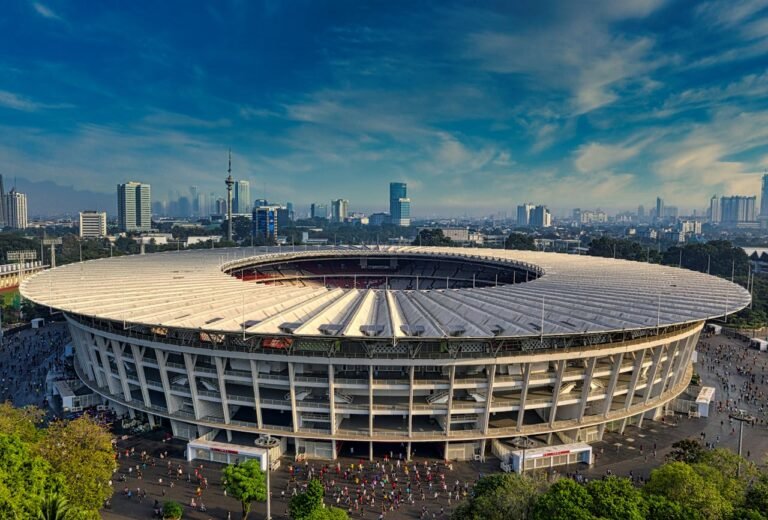
Sweden has a rich sporting culture and its football stadiums reflect that. Stadiums range from national arenas that host international matches to custom-built stadiums for top-flight Allsvenskan clubs. Unlike many other European footballing nations whose biggest stadiums are concentrated around the capital cities, Sweden’s biggest stadiums are spread around the country, from Malmö in the south to Umeå in the north. The stadiums below are multi-purpose stadiums used for athletics, concerts and community activities as well as football. They are examples of the Swedish model of publicly accessible multi-purpose infrastructure.
The larger stadiums in Sweden have mainly been built or heavily redeveloped for major international tournaments such as the 1958 FIFA World Cup (hosted by Sweden) and the 1992 UEFA European Championship (co-hosted with Denmark). More recently, stadium modernization has been driven by UEFA licensing requirements for minimum capacities, media facilities and safety standards for clubs competing in European competitions. The 5 biggest stadiums in the world by official seated or total capacity. But the focus is on football configuration, not peak concert or athletic capacity.
Top 5 Largest Football Stadiums in Sweden
- Friends Arena (Solna/Stockholm)
- Tele2 Arena (Stockholm)
- Gamla Ullevi (Gothenburg)
- Eleda Stadion (Malmö)
- Nya Parken (Norrköping)
A Closer Look at the Top 5 Largest Football Stadiums in Sweden
1. Friends Arena
Friends Arena is the largest football stadium in Sweden and the national stadium for the Swedish men’s football team. It is located in Solna, just north of central Stockholm. The venue opened in 2012 on the site of the old Råsunda Stadium, which had served as Sweden’s national stadium since 1937. Friends Arena was constructed primarily for football but includes a retractable roof, making it suitable for year-round events, including concerts, conferences and other sports.
Key Points
- Football matches: 50,000 seated spectators (official capacity)
- All weather retractable roof for play (closing time about 20 minutes)
- UEFA Category 4 stadium (top classification) capable of hosting Champions League and Europa League finals
- Home of AIK, the Allsvenskan club and Sweden national football team
Notable Features
- Retractable roof: construction with ETFE (ethylene tetrafluoroethylene) cushion (allows natural light in)
- Hot tar, Under-pitch heating wires keep the course playable from March through November
- Media facilities: 200 seats for journalists, broadcast studios and fibre-optic links for international feeds.
- Access: 300 wheelchair spaces, hearing loop, access for guide dogs.
Major Events Hosted
- Sweden national team games (2012–present)
- AIK (2013–present) Home games
- Ajax vs. Manchester United – 2017 UEFA Europa League Final
- Swedish Cup final (2013–now)
- Various concerts (Beyoncé, Ed Sheeran, Coldplay, Rammstein etc.)
Feedback
Spectators say the sight lines and access to the concourse are better than at the old national stadium. The retractable roof has been praised for games in autumn and winter, meaning that the weather does not hold up play. Some say the athletics track (required for athletics certification) means spectators are further away from the pitch than they would be in a football-only configuration. Touring sound engineers often sing praises for the acoustics of the roof design for concerts.
Contact Information
Website: www.friendsarena.se
2. Tele2 Arena
Tele2 Arena is a multi-purpose retractable roof stadium in Johanneshov, in the south of Stockholm, adjacent to Avicii Arena and the Stockholm Globe City complex. The arena opened in 2013 and was built to host football and bandy, a winter sport similar to ice hockey but played with a ball. It is Scandinavia’s most used big stadium and is used by the two Allsvenskan clubs Hammarby IF and Djurgårdens IF.
Key Points
- Official capacity (football): 30,000 seated (maximum 33,000 including standing areas for domestic matches)
- 225 meters long, one of Europe’s largest retractable roofs
- UEFA Category 4 stadium, eligible to host finals of European club competitions
- Hammarby IF and Djurgårdens IF home ground (rotating schedules)
Notable Features
- Hybrid pitch: 20 metre synthetic fibres reinforce natural grass for heavy wear
- Standing areas: Rail-seating in accordance with UEFA rules for home games
- Bandy setup Ice surface can be laid on pitch. Requires full climate control
- Transport connection Close to Globen metro station (Green Line) and Stockholm commuter train
Major Events Hosted
- Hammarby IF Home Fixtures (2013-)
- Djurgårdens IF home matches (2013–)
- 2017 UEFA Europa League group stage matches
- Final of the Swedish men’s bandy championship
- Major Concerts (e.g. Bruce Springsteen, Metallica, The Rolling Stones)
Feedback
The capacity of 30,000 is not large, but both clubs’ fans enjoy the intimacy of the ground and the steep gradients improve sight lines. The stadium is very accessible by public transportation, but there are reports of congestion on the Green Line after the game. The roof was designed with sound attenuation, but some neighbors complain about noise levels on match days. Both clubs use the pitch and the players consistently rate the quality as excellent.
Contact Information
Website: www.tele2arena.se
3. Gamla Ullevi
Gamla Ullevi is a football-only stadium in central Gothenburg, opened in 2009 on the site of the original Ullevi Stadium (from which it takes its name, although it is a new build). It is the home ground of two Allsvenskan clubs, IFK Göteborg and BK Häcken. It is sometimes used for matches of the Sweden women’s national football team. Gamla Ullevi’s steep stands and great acoustics create a tough home atmosphere.
Key Points
- Football: 18,416 (all-seater)
- Designed for football, not athletics, no track to divide fans from the pitch
- UEFA Category 4 stadium suitable for European group stage games
- Home of IFK Göteborg and BK Häcken and some Sweden women’s matches
Notable Features
- Steep seating gradient: 34-degree angle for upper tier (one of the steepest in Scandinavia)
- Integrated floodlighting: An LED system integrated into the roof structure minimizes light spill.
- Hybrid pitch: Natural grass with under-soil heating and drainage system
- Stand names: Four separate stands (Övre, Nedre, Klacken & Gamla Ullevi Stand) with separate supporter sections
Major Events Held
- Home matches at IFK Göteborg (2009–)
- BK Häcken home matches (2009–present)
- UEFA U-21 Championship Final 2015 (Portugal vs Sweden)
- Swedish Cup finals (certain years without Friends Arena availability)
- Selected results of the Sweden women’s national football team (2013–)
Feedback
Gamla Ullevi stands steeply, has covered acoustics and has consistently been voted as having the best atmosphere in Swedish football. Players rave about the quality of the pitches even in the winter months. The concourse can get busy at peak times, some visitors say. The location is central, within walking distance of Gothenburg Central Station, which travelling supporters rate highly.
Contact Information
Website: www.gamlaullevi.se
4. Eleda Stadion
Eleda Stadion (previously known as Swedbank Stadion and Malmö Stadion for sponsorship reasons) is the home of Sweden’s most successful club, in terms of Allsvenskan titles and appearances in European competition, Malmö FF. The stadium opened in 2009, next to the old Malmö Stadion (built for the 1958 FIFA World Cup) and the indoor venue Malmö Arena. Eleda Stadion was built for football only, without an athletics track and with the proximity of spectators to the pitch optimised.
Key Points
- Official capacity for football: 22,500 (all-seated)
- UEFA Category 4 stadium, regularly hosting Champions League group stage matches
- Named one of Europe’s most environmentally sustainable stadiums at time of construction
- Home venue for Malmö FF, Allsvenskan champions with record 23 Swedish titles
Notable Features
- Closed corners: Four connected stands forming a closed bowl, giving better acoustics and weather protection
- Deep geothermal system + district heating from local waste-to-energy plant for underground heating
- LED floodlights: Full LED system with dynamic control for pre-match shows and energy saving
- Designing for sustainability: rainwater harvesting for pitch irrigation, solar PV on concourse roofs and recycled steel for construction
Major Events Hosted
- Malmö FF home matches (2009–)
- UEFA Champions League group stage matches (2014-15, 2015-16, 2018-19, 2021-22 seasons)
- UEFA Europa League knockout phase matches (various seasons)
- Sweden national team fixtures (select matches, usually when Friends Arena is unavailable)
- 2021 Allsvenskan title-deciding game (Malmö FF vs IFK Göteborg)
Feedback
The pitch at Eleda Stadion is always rated as the best in Allsvenskan by visiting teams and officials, thanks to geothermal heating and the professional grounds team. Malmö’s fans like the bowl shape, which makes for a ‘cauldron’ atmosphere on European nights. Some have criticized its 22,500 capacity as limiting ticket availability for high-demand matches, although expansion has been broached. Away fans receive an average score for accessibility, with a separate entrance and limited space in the concourse.
Contact Information
Website: www.mff.se/eleda-stadion
5. Nya Parken
IFK Norrköping play their home games at Nya Parken, currently known as the PlatinumCars Arena for sponsorship reasons. It is in the city of Norrköping in Östergötland County. It was built for the 1958 FIFA World Cup and has undergone several renovations, most recently in 2009 and 2016. Nya Parken is the biggest football stadium in Sweden outside the metropolitan areas of Stockholm, Gothenburg and Malmö, but it is smaller than the four biggest stadiums.
Key Points
- Football capacity (official) 17,234 (all-seater)
- Serving Eastern Sweden, approximately 160 km south of Stockholm
- UEFA Category 4 stadium, enabling IFK Norrköping to play European group stage matches
- IFK Norrköping, 13-time champions in Allsvenskan
Notable Features
- Historic floodlight pylons: Preserved pylons from the 1958 World Cup get an upgrade with LED technology
- Family section dedicated stand, alcohol free, family friendly facilities, special pricing
- Stand naming: 4 different stands (Klacken, Övre Läktare, Nedre and Bortaläktare) with the active supporters in the stand Klacken
- Pitch orientation: North-south to avoid sun glare for players and spectators
Major Events Hosted
- IFK Norrköping home games (1958 – now, with renovation breaks)
- 1958 FIFA World Cup Matches (Group Stage including Brazil v U.S.S.R.
- 1992 UEFA European Championship, Group Stage, Denmark vs. England
- Sweden national team B matches & youth internationals
- 2015 Allsvenskan Champions (IFK Norrköping vs. Malmö FF)
Feedback
Fans love the cozy atmosphere and the fact that all the stands have unobstructed views. The preservation of the historic floodlight pylons is praised as protecting football heritage. Some visitors say the concourse facilities are dated compared to the four larger stadiums, despite recent renovations. Away supporters report good segregation and signage. The location in the city center within walking distance to Norrköping Central Station gets consistently good ratings.
Contact Information
Website: www.ifknorrkoping.se/nya-parken
Frequently Asked Questions
Which is the largest football stadium in Sweden by capacity?
The largest is Friends Arena in Solna (Stockholm metropolitan area) with an official football capacity of 50,000 seated spectators. The functional capacity for domestic Allsvenskan games with standing areas allowed is around 54,000, but UEFA regulations require all-seater configurations for European competitions.
Why does Sweden not have a stadium with a capacity larger than 50,000?
Sweden’s population is 10.5 million and attendance patterns are normal, so there is no justification for building bigger stadiums. The average Allsvenskan attendance in 2024 was the highest ever at 28,000 (AIK at Friends Arena, limited by away fan allocation). And the running costs for larger venues would be high, with no matching revenues. And too, the building regulations and climate considerations (heating and roof requirements) have increased the costs of construction to levels that are no longer economically viable for larger capacities.
Which stadiums hosted matches during the 1958 FIFA World Cup?
The three stadiums featured above were sites for matches in the 1958 World Cup: Gamla Ullevi (the original Ullevi stadium then), Eleda Stadion (the original Malmö Stadion) and Nya Parken (the original Norrköping venue). Friends Arena and Tele2 Arena were built on different sites after 1958. The original Råsunda Stadium in Solna was demolished in 2012 and replaced by Friends Arena. The 1958 final was played at the original Råsunda Stadium.
Can the public tour these stadiums on non-match days?
Yes, there are public tours of all 5 stadiums. Friends Arena and Tele2 Arena offer daily tours, including access to the pitch, dressing rooms, media areas and viewing platforms at roof level (weather permitting). Tours of Gamla Ullevi, Eleda Stadion and Nya Parken are offered on non-match days, booked in advance through respective club websites. Tour prices are SEK 95-250 for adults, with reduced prices for children, students and old people.
Which stadium is best for spectators who require accessibility accommodations?
Friends Arena and Tele2 Arena have the most extensive accessibility features, with dedicated spaces for wheelchair users (over 300 at Friends Arena), elevator access to all levels, hearing loops at service counters, guide dogs allowed and accessible toilets on every concourse. Gamla Ullevi and Eleda Stadion are accessible but have limited dedicated spaces and some stepped access ways. Nya Parken is wheelchair accessible, but there is only limited elevator access to upper levels. Ask stadium accessibility staff about accommodations available in advance.
How do Swedish stadiums manage winter matches and snow?
All five stadiums have under-soil heating (electric or hydronic) to prevent the pitch from freezing and to help melt snow. Play will take place in light to moderate snow, but heavy snow could slow things down if lines are not visible. Both Friends Arena and Tele2 Arena have retractable roofs, so games are never cancelled due to snow. Gamla Ullevi, Eleda Stadion and Nya Parken are open-air and snow clearance is done through heated pitch systems and by hand from seating. Postponements are rare (average 1 per 10 seasons) due to heating systems and Swedish winter preparedness.
Which Allsvenskan clubs share stadiums?
* Tele2 Arena, in Stockholm, is jointly used by Hammarby IF and Djurgårdens IF with alternating match schedules and separate branding for each club (electronic signage, removable banners and separate changing rooms). IFK Göteborg and BK Häcken are sharing Gamla Ullevi in Gothenburg on an alternate basis. No other Allsvenskan teams share the same stadium. Shared stadiums can save construction and operational costs but require careful scheduling and match-day segregation.
Are these stadiums used for non-football events?
Yes. Friends Arena and Tele2 Arena are the venues for major concerts, conferences, trade fairs and corporate events all year round. Concerts are not the main priority, but there are occasional shows at Gamla Ullevi and Eleda Stadion. Nya Parken is primarily a football stadium, with few non-football events. Non-football income helps to run football, particularly at the two Stockholm venues where concert bookings supplement competition income.
