
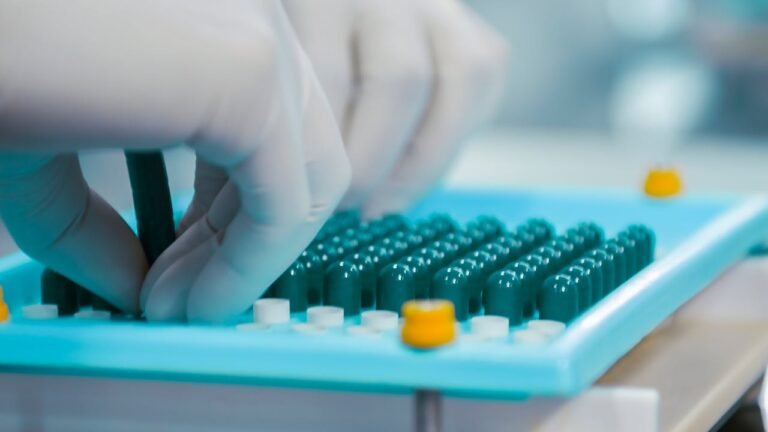
Sweden has developed a unique position in European biomanufacturing and pharmaceutical manufacturing, with world-class process engineering, strict regulatory compliance, and a long history in life sciences. Home to Medicon Valley – the Øresund region shared with Denmark – the country develops more medicines than any other life science cluster in the EU, except Paris, with 100 companies actively developing 502 medicines. This cluster also has more Contract Development and Manufacturing Organizations (CDMOs) than any other pharmaceutical region in Europe, a segment known as the “golden vein” of the biopharma industry.
What makes the Swedish production facilities unique is their strategic positioning along the entire pharmaceutical value chain, from the synthesis of active pharmaceutical ingredients (APIs) to advanced biologics and the building of modular facilities. Key players such as Recipharm, Cambrex, and Ardena have GMP-compliant sites with regulatory approvals from the Swedish MPA, U.S. FDA, and Japan’s PMDA. At the same time, innovative companies like KeyPlants are redefining the way pharmaceutical facilities are built, enabling clients to accelerate time-to-market by eight to ten months using modular construction. The following five facilities are the most powerful demonstration of Swedish biomanufacturing capability.
Top 5 Swedish Biomanufacturing and Pharma Production Facilities
- Recipharm Uppsala
- Cambrex Karlskoga
- Ardena/Nanologica Södertälje (Syntagon AB)
- Cobra Biologics (Matfors and Södertälje facilities)
- KeyPlants AB (Götene)
A Closer Look at the Top 5 Swedish Biomanufacturing and Pharma Production Facilities
1. Recipharm Uppsala
Recipharm’s Uppsala site is a central pharmaceutical manufacturing facility in Sweden, focusing on the manufacturing of active pharmaceutical ingredients (APIs) and oral solid dosage forms and suppositories. The site is fully integrated into Recipharm’s global CDMO network and supports customers worldwide with high-quality, compliant manufacturing throughout the full product lifecycle. Recipharm itself is a multi-modal CDMO with a large European footprint in Sweden, Germany, Italy, Spain, and Portugal.
Key Points
- Core manufacturing capabilities: API, coated and uncoated tablets and suppositories.
- Integrated operations Packaging, bulk product handling, bottling, serialization, manual aggregation processes, and EU release of finished products.
- Regulatory approvals: Approved and inspected by the Swedish MPA (EU GMP), US FDA, and Japan’s PMDA.
- Certifications: ISO 14001 (Environmental Management) and ISO 45001 (Occupational Health & Safety Management); EcoVadis Bronze rating for sustainability.
Achievements
- The Uppsala site is closely linked to Recipharm’s global CDMO capabilities to support the full product life cycle.
- Recipharm is a leading European CDMO, with a network of sites delivering biologics, sterile fill-finish, and clinical materials.
- Has several worldwide regulatory approvals enabling us to distribute to the world’s leading pharmaceutical markets.
Feedback
Recipharm Uppsala is considered a solid partner in both clinical and commercial manufacturing, with a strong heritage in small molecule APIs and solid dosage forms. Clients wanting end-to-end solutions appreciate the site’s integrated packaging and serialization capabilities. The EcoVadis Bronze rating is an indication of active commitment to sustainability, which is becoming an increasingly important factor for pharmaceutical customers.
Contact Information
Website: https://www.recipharm.com
2. Cambrex Karlskoga
In Karlskoga, Sweden, Cambrex operates a large small-molecule drug substance manufacturing facility with more than 400 people. The site offers a wide range of flexible manufacturing capabilities, including four cGMP pilot plants and five full-scale commercial production lines. Cambrex is a leading small molecule CDMO, providing drug substance, drug product, and analytical services across the entire drug lifecycle.
Key Points
- Staffing and scale: >400 employees; 4 cGMP pilot plants, 5 full-scale commercial production units.
- Recent expansions: In 2019, the site added a new 600 m² process and analytical development facility and a 3,000 m² logistics center.
- Flexible capacity: In 2020 Cambrex announced an investment of $3.6 million to convert a previously customer-dedicated manufacturing train, adding a 6 m³ production line for a 25% increase in capacity.
- Core Technologies: Biocatalysis Continuous flow controlled substances High-potency APIs Solid-state science
Achievements
- Opened a new 600 m² process and analytical development facility and a 3000 m² logistics center (2019).
- Completed engineering modifications including a new 4 m² Hastelloy Rosemund filter and new holding tanks.
- Offers end-to-end small molecule lifecycle services from development through commercial manufacturing.
Feedback
Bjarne Sandberg, managing director of Cambrex Karlskoga, noted the company is “seeing continued growth in commercial-scale API manufacturing and an ongoing trend for customers favoring high-quality European and US partners.” The Karlskoga site’s flexible configuration—offering both pilot and commercial scale—is a key differentiator, allowing seamless scale-up without transferring processes between facilities.
Contact Information
Website: https://www.cambrex.com
3. Ardena / Nanologica Södertälje (Syntagon AB)
The recent history of the Södertälje drug substance facility is complex but strategically important. The site, which was owned by Ardena as an API CDMO, was sold to Nanologica AB in January 2026 and has since returned to its original name of Syntagon AB. The facility employs over 45 people and has a strong track record in small molecule API manufacturing, supporting programs from early development through clinical supply to commercial production. Ardena continues as a customer under a services agreement and is still a shareholder of Nanologica.
Key Points
- Facility specialization: Small molecule API CDMO with strong investment in chromatographic purification and falling film distillation capabilities.
- Development to commercial scale: Supports programs from early development through clinical supply to full commercial manufacturing.
- New owners (2026): Now owned by Syntagon AB (wholly owned subsidiary of Nanologica AB)
- Continued collaboration: Ardena will remain a shareholder and will continue to work on new customer projects.
Achievements
- The divestment is aligned with Ardena’s strategic focus on “specialized capabilities that enable precision medicines,” including nanomedicine and drug conjugates.
- As part of the agreement, Jeremie Trochu, CEO of Ardena, will join Nanologica’s Board of Directors. Major recent investments have also been made in purification and distillation technologies at the site.
- The site has benefited from significant recent investments in purification and distillation technologies.
Feedback
The move to Nanologica ownership is a sign of confidence in the continued operation and growth of the site.” Swedish life science tools company Nanologica, which specializes in silica-based purification products for peptide drugs (including insulin and GLP-1 analogues), is well placed to assist the Södertälje team. Ardena’s current customers will continue to be supported through the existing services agreement.
Contact Information
Website: https://nanologica.com/
4. Cobra Biologics (Matfors and Södertälje facilities)
Cobra Biologics has two GMP-approved sites in Sweden, a fill-finish and microbial-based protein production site in Matfors and a mammalian production site in Södertälje. The company works with the global life sciences industry to develop and manufacture biologics, including monoclonal antibodies (mAbs), recombinant proteins, DNA, viruses, phages, and cell line-derived products.
Key Points
- Matfors facility: Fill-finish and microbial-based protein production; best-in-class sterile drug product fill-finish with freeze-drying/lyophilization capabilities.
- Södertälje site: Production of complex biologics in mammalian cell culture.
- Fill-finish capacity: Up to 4,000 units/hour for small molecules in single-use syringesor injected vials.
- Clinical to commercial supply: Experience in supplying parenteral products for clinical trials and for commercial, in-market supply.
Achievements
- In 2011, Cobra acquired a flexible fill-finish facility from UniTech Pharma, enabling the company to broaden its services to include sterile drug product manufacturing.
- A commercial contract with ‘an emerging leader in specialty pharmaceuticals.’
- Multi-functional project teams nurture products through clinical and commercial manufacture at all three GMP-approved sites (including the UK facility).
Feedback
Cobra is known for providing end-to-end biologics services from DNA to finished drug products. The separation of capabilities between sites (microbial in Matfors, mammalian in Södertälje) allows facilities appropriate to the technology. Clients at different points in clinical development appreciate the flexibility of the fill-finish line to handle both syringes and vials.
Contact Information
Website: https://www.selectscience.net/company/cobra-biologics
5. KeyPlants AB (Götene)
KeyPlants AB is in a unique category in biomanufacturing; the company builds modular pharmaceutical manufacturing facilities, not that the company itself manufactures drugs. In February 2026, KeyPlants announced a major expansion to Götene, Sweden, to double its current production capacity to meet a large-scale order and a strong pipeline of projects. “The modular approach allows pharmaceutical customers to get a facility ready in eight to ten months faster than traditional on-site construction.
Key Points
- Modular Manufacturing: Fabricate large steel modules for fast-delivered modular facilities for life sciences and advanced technology industries.
- Expansion details: Four-year lease agreement on Götenehus industrial site. Production expected to start on 1 March 2026.
- Capacity impact: Doubling of existing capacity; two to three more major projects already in the pipeline.
- Job creation: Expected to generate approximately 70 jobs, including 15–20 new positions in Götene.
Achievements
- KeyPlants’ modular approach enables pharma companies to “complete a pharmaceutical facility eight to ten months faster compared with traditional on-site construction,” said CEO Sven Lans.
- The establishment is “significant… equivalent to about 300 jobs in a city the size of Skövde,” says Johan Månsson, Chair of the Municipal Executive Committee in Götene.
- Assemblers and warehouse personnel are being recruited.
Feedback
KeyPlants solves a major bottleneck in pharma scale-up: the time to build a facility. Traditional brick-and-mortar pharma plants can take 24 to 36 months from groundbreaking to operation, but KeyPlants’ modular approach compresses that timeline dramatically. The reason to expand to Götene is “an increasingly strong project pipeline” and “a recently secured large-scale order,” which shows that there is a strong demand for fast-to-deploy manufacturing capacity.
Contact Informatiom
Website: https://keyplants.com/
FAQ
What is a CDMO, and why are there so many in Sweden?
CDMO stands for Contract Development and Manufacturing Organization—companies that develop and manufacture drugs for other pharmaceutical companies. Medicon Valley (the Øresund region) boasts “more CDMOs than any other pharmaceutical cluster in Europe,” a segment described as the “golden vein” of the biopharma industry. Sweden’s high concentration reflects its strong chemistry and engineering heritage, regulatory excellence, and proximity to major Nordic and European pharma companies.
Which regulatory authorities have approved Swedish manufacturing facilities?
Swedish facilities are regularly inspected and approved by a number of global regulators. For example, Recipharm Uppsala has approvals from the Swedish MPA (EU GMP), the U.S. FDA, and Japan’s PMDA. This multi-regulatory approval allows products manufactured in Sweden to be delivered to major pharmaceutical markets around the world without re-inspection or re-qualification.
What is the significance of the Ardena to Nanologica transition in Södertälje?
Ardena sold its Södertälje drug substance site to Nanologica AB in January 2026. The company now functions as a wholly owned subsidiary under its original name Syntagon AB. Ardena remains a shareholder and will continue to work together on new customer projects. This transition is consistent with Ardena’s strategic focus on precision medicine capabilities (nanomedicine, drug conjugates) and the continued operation of the Södertälje site under an owner with complementary expertise in purification technologies.
How does modular construction (KeyPlants) differ from traditional pharma facility development?
Traditional pharmaceutical facilities are site-built and sequential and generally take 24 – 36 months. KeyPlants’ modular concept is to produce large steel modules in the factory (Götene) and simultaneously do the site preparation. Modules are then delivered and assembled on site. “This approach allows clients to ‘finish a pharmaceutical facility eight to ten months sooner,'” CEO Sven Lans said, a dramatic acceleration that is critical when drug launches are time-sensitive.
What biologics manufacturing capabilities exist in Sweden?
Sweden has large biologics capabilities at several sites. Cobra Biologics has separate facilities for microbial-based protein production (Matfors) and mammalian production (Södertälje) with monoclonal antibodies, recombinant proteins, DNA, viruses, and phage. Diamyd Medical is setting up a biomanufacturing facility in Umeå for the production of recombinant GAD65, the active substance in its diabetes vaccine candidate.
Which Swedish facility is best for small molecule API manufacturing?
Both Cambrex Karlskoga and Recipharm Uppsala are great options for small molecule API manufacturing with different strengths. Cambrex provides large pilot and commercial scale capabilities (more than 400 employees, 4 pilot plants, and 5 commercial units) with specialized technologies, including biocatalysis and continuous flow. At Recipharm Uppsala we have the complete API-to-tablet solution, including packaging and serialization, all under one roof.
What new pharmaceutical facility developments are underway in Sweden?
KeyPlants AB expands to Götene, doubling its production capacity for modular pharmaceutical facilities. Production is planned to start in March 2026. Diamyd Medical is building a 10,000-square-foot biomanufacturing facility in Umeå for the production of recombinant proteins. The company is investing approximately SEK 20 million to get started.
How does the Medicon Valley cluster support pharmaceutical production?
Medicon Valley is a transnational cluster between the Copenhagen and Skåne regions that develops more medicines than any other life science cluster in the EU except for Paris. The largest companies with ongoing drug development in the region are Novo Nordisk (109 drugs), Lundbeck (48), Genmab (31), Leo Pharma (30), and Alk-Abelló (14). The cluster provides a rich network of expertise, suppliers, and regulatory knowledge that supports the CDMOs and manufacturers described above.
