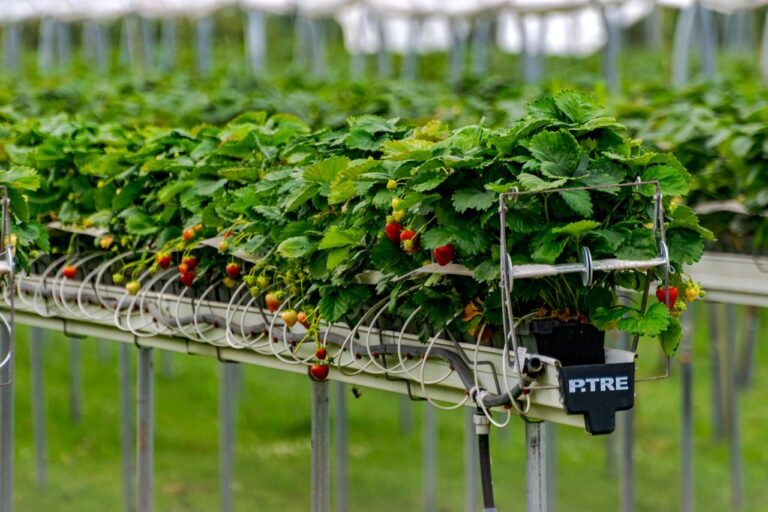
Technology is transforming Mexico’s agricultural sector—and for good reason. The country faces serious challenges: water scarcity, climate volatility and the need to feed a growing population while protecting the environment. “AgriTech is stepping up to the plate to meet these challenges.
The figures tell the story. In 2025, Mexico attracted more than $40 billion in foreign direct investment, with billions pouring into industrial hubs and logistics infrastructure that support agricultural innovation. The global AgTech market is growing rapidly, driven by a growing population, increased food demand and climate pressures.
What sets Mexico’s AgriTech scene apart is that it’s not just about cool ideas but real-world solutions. Here, companies are not just playing with technology. They are creating practical tools that help farmers increase yields, manage water and reduce their dependence on chemicals. Mexican innovators are proving that local science can have a global impact, from analyzing the soil microbiome to AI-powered risk monitoring.
If you’re interested in the future of farming in Mexico, here are five AgriTech companies leading the way.
1. Bayer Mexico
Bayer is a global giant, but their work in Mexico is certainly worth highlighting. The company has turned Mexico into a center for agricultural innovation, where it has created new crop hybrids and digital farming services that adapt to local conditions.
Bayer stands out because of its commitment to science locally. In Jalisco, their research center has developed new corn hybrids with stronger stalks and deeper roots that can withstand winds of over 50 kilometers per hour. These plants are about a meter shorter than traditional varieties and this feature allows farmers to grow denser fields with 30 to 40% more plants per hectare while using fewer nutrients.
The company is also tackling water scarcity through digital tools. Their AI-powered service Carlota monitors soil moisture and helps farmers optimize irrigation. Bayer reports they’ve served over 20,000 hectares across more than 30 different crops and saved 14 million cubic meters of water alongside farmers—equivalent to 5,600 Olympic swimming pools. Their Fieldview tool provides forecasting models for diseases and pests, shifting agriculture from corrective to preventive approaches.
Bayer’s philosophy is clear: local science can have global impact. They’re developing innovations in Mexico and planning to bring them to Argentina, Brazil and the US.
Who should partner with Bayer? Large-scale farmers and agribusinesses looking for comprehensive solutions combining crop genetics, digital tools and sustainability support.
Official Website: https://www.bayer.com.mx
2. Grupo Solena
Grupo Solena is a Mexican AgriTech company based in Guanajuato, working on one of the most neglected areas in agriculture: soil health. The company, founded in 2017, provides analysis of the soil microbiome, giving farmers knowledge to improve crop yield and sustainability.
What’s particularly noteworthy about Solena is that they are partners. They’re working with Mercy Corps Ventures on pilots that use AI to improve soil health and crop production for sugarcane farmers in Mexico. Their aim is to develop financially viable and scalable products that can be delivered to smallholder farmers in a cost-effective manner.
Solena offers soil health assessments, agriculture insights and farm solutions to improve soil quality and farm productivity. They have received investment from organizations such as SAP.iO Foundry Latin America, Apple Impact Accelerator, CerraCap Ventures and Illumina Accelerator.
The company’s focus on smallholder farmers is particularly important. Small farms make up a large part of agricultural production in Mexico and providing them with affordable, scalable options can make a big impact in rural communities and for food security.
Who is Solena for? Farmers and agribusinesses who want to improve soil health and sustainability, especially those working with smallholder farmers who need affordable solutions.
Official Website: https://www.gruposolena.com
3. Agroberries Capital Group
Agroberries Capital Group, based in Zapopan, Jalisco, is using technology to revolutionize raspberry farming. The company uses a model that combines macrotunnels, automated fertigation, proprietary beehives for pollination and advanced soil biotechnology.
Mexico is one of the world’s top raspberry exporters and there are good reasons why Agroberries has chosen this crop. The raspberry is a complex and demanding crop,” says the company’s president, Carlos de Losada. This is why we chose it. Because we have the right conditions to grow it rigorously.
The company has 12 hectares of raspberries in Atotonilquillo, Jalisco and harvests twice a year. Each step of the production is traceable and audited according to the Global GAP and ISO 22000. They also line up sales contracts before planting, which minimizes market risk and guarantees product placement.
Agroberries also tackles environmental issues. They do not allow agrochemicals and have their own water supply system. Trained technical staff and local workers carry out real-time monitoring and data management to ensure quality and community engagement.
Who should work with Agroberries? Retailers and distributors looking for high-quality, traceable raspberries from a tech-driven operation that prioritizes sustainability.
Official Website: https://agroberries.com
4. MicroIN
MicroIN is a Mexican startup that is making a significant impact in sustainable agriculture. Victoria Conde and Miguel Berretta founded the company that has been awarded the Sustainability Prize by the KM ZERO Food Innovation Hub for its work in regenerating soil with bio-inputs.
What is unique about MicroIN technology? Bio-inspired solutions based on microencapsulation strategies are used to optimize the formulation and stability of biological products. It speeds up the development of stable and efficient products while reducing costs in production, transportation and storage—solving a problem that costs the industry an estimated $10 billion USD per year.
The company is committed to changing a production system that is too dependent on chemical products. Chemicals remove pests, but they also harm the soil and human health. MicroIN provides sustainable solutions to regenerate agricultural soils and reduce chemical use.
“MicroIN reminds us that there is no future for food without a sustainable countryside,” said Beatriz Jacoste, CEO of KM ZERO. The award links MicroIN to over 200 companies and institutions in the food sector and 40 investment funds with access to 5 billion euros of resources.
Who should work with MicroIN? Farmers and agribusinesses looking to transition away from chemical inputs toward sustainable, bio-based alternatives for soil regeneration.
Official Website: https://www.microin.mx
5. Sinecta
Sinecta is a Sonoran startup founded in 2020 by Antonio Pacheco, a professor at Tecnológico de Monterrey. The company uses artificial intelligence to calculate risks in the agricultural industry, providing technological tools to financial institutions like banks and insurance companies.
Their platform processes data collected by satellites and sensors in agricultural fields, translating it into actionable information for decision-making. This enables remote, real-time monitoring of crops and anticipation of risks that affect productivity.
But what is particularly innovative about Sinecta is its partnership with FIRA (Trust Funds for Rural Development). Their platform has been identified as an official channel for remotely monitoring agricultural loans, which gives financial institutions the confidence to lend to farmers.
Currently, the company operates in Sonora, Sinaloa, Tamaulipas, Veracruz and Campeche, monitoring more than 135,000 hectares. Their work was recognized in Fintech Americas 2025, when they won the Insurtech Pitch OFF competition.
Pacheco’s experience as a professor has been a critical factor in the company’s success. Some of his current partners were once his students, testimony to the ability of academic collaboration to lead to innovation.
Who should work with Sinecta? Financial institutions offering agricultural loans, insurance companies and large-scale farmers looking for data-driven risk management tools.
Official Website: https://sinecta.com
Why Mexico’s AgriTech Sector Matters
The AgriTech space in Mexico is at a crossroads. The country faces significant challenges such as water scarcity, climate volatility and feeding a growing population. Technology is the solution.
The sector is getting some serious investment. UPL Corporation, a global leader in sustainable agricultural solutions, has recently invested $1.5 million USD in new high-tech greenhouses in Mexico. These are the first fully automated glass greenhouses in the country, constructed in Coahuila, as part of a Global Research Center that has received more than $5 million USD in investment since 2023.
Bayer is also investing heavily in Mexico, developing new crop hybrids in Jalisco and digital tools to help farmers manage water. “Local science can have a global impact,” states Bayer Mexico CEO and President, Manuel Bravo.
The government also has gotten in to support the sector. Programs such as the National Institute for Entrepreneurs (INADEM) and tax incentives for R&D are contributing to a more favorable environment for AgriTech innovation.
Challenges Facing Mexican AgriTech
Progress has been made, but challenges remain. Climate change is making the weather more unpredictable. Droughts and floods are becoming more frequent. According to CONAGUA, Mexico’s national water agency, Mexico has experienced high variability in rainfall in recent years.
Another big issue is chemical dependency. Many farmers are still reliant on pesticides and synthetic fertilizers, which are detrimental to soil health and biodiversity. Alternatives are in the pipeline, such as biopesticides to protect corn from MicroIN and Alebricks.
Many smallholder farmers still have difficulty accessing financing. Some companies like Sinecta are helping by providing data that allows financial institutions to make better lending decisions.
The Future of AgriTech in Mexico
The outlook for AgriTech in Mexico is positive. Several factors point to continued growth and innovation:
- Nearshoring momentum: Production is moving closer to the US market and agricultural supply chains are part of this migration.
- Climate tech opportunities Capital is pouring into solutions for water scarcity, renewable energy and sustainable agriculture.
- Government support involves creating a better environment for R&D and entrepreneurship incentives.
- Academic collaboration: Universities such as Tecnológico de Monterrey are producing talent and spin-offs that stimulate creativity.
Mexico’s young population, growing digital economy and improving regulatory environment make it an attractive destination for both local and international AgriTech investors.
FAQ
What is AgriTech and why does it matter in Mexico?
AgriTech refers to the use of technology in farming to improve efficiency, productivity and sustainability. In Mexico, it matters because the country faces challenges like water scarcity, climate volatility and the need to feed a growing population. AgriTech solutions help farmers produce more with fewer resources.
How is technology helping Mexican farmers deal with water scarcity?
Bayer and other companies are developing AI-powered tools, such as Carlota, that track soil moisture and help farmers improve their irrigation. The service has helped save 14 million cubic meters of water in more than 20,000 hectares of farmland in Mexico.
What’s happening with soil health in Mexican agriculture?
Companies like Grupo Solena and MicroIN are working on soil regeneration. Solena offers analysis and insights on the soil microbiome to increase crop production. MicroIN develops bio-inputs to replace chemical products and restore soil health.
Which Mexican AgriTech companies are getting international recognition?
MicroIN won the Sustainability prize from the KM ZERO Food Innovation Hub and met more than 200 corporations and 40 investment funds. Sinecta Wins Insurtech Pitch-off Competition at Fintech Americas 2025 Bayer creates innovations in Mexico and sells them to other countries.
How is Mexico’s government supporting AgriTech?
Mexico has programs like INADEM (National Institute for Entrepreneurs) and tax incentives for R&D. Organizations like FIRA (Trust Funds for Rural Development) work with startups like Sinecta to offer formal monitoring mechanisms for agricultural loans.
What are the biggest challenges facing Mexican AgriTech?
Key challenges are climate change, water scarcity, chemical dependence and access to finance for smallholder farmers. But these challenges also provide opportunities for innovation and many companies are working on solutions to the problems.
Are international companies investing in Mexican AgriTech?
Sure. UPL Corporation has invested $1.5 million in high-tech greenhouses in Coahuila and Bayer has made Mexico a strategic hub for agricultural innovation. For multinationals, Mexico serves as a test site for solutions that they can sell to other markets.
How can startups access funding in Mexico’s AgriTech sector?
There are many ways to do so, including government programs like INADEM, venture capital firms, corporate venture arms like Bimbo Ventures and international accelerators. Programs such as KM ZERO connect startups with corporations and investment funds.
What role do universities play in Mexican AgriTech?
Universities such as Tecnológico de Monterrey generate talent and spin-offs. Sinecta was founded by a professor from Tec de Monterrey, who had some former students as partners. Academic collaboration is a central driver of innovation in the sector.
How does nearshoring affect Mexican AgriTech?
Companies are bringing production closer to the US market, driving investment in Mexico’s agricultural sector. This opens up opportunities for technology providers that can assist in enhancing efficiency, lowering costs and meeting sustainability standards for export markets.